

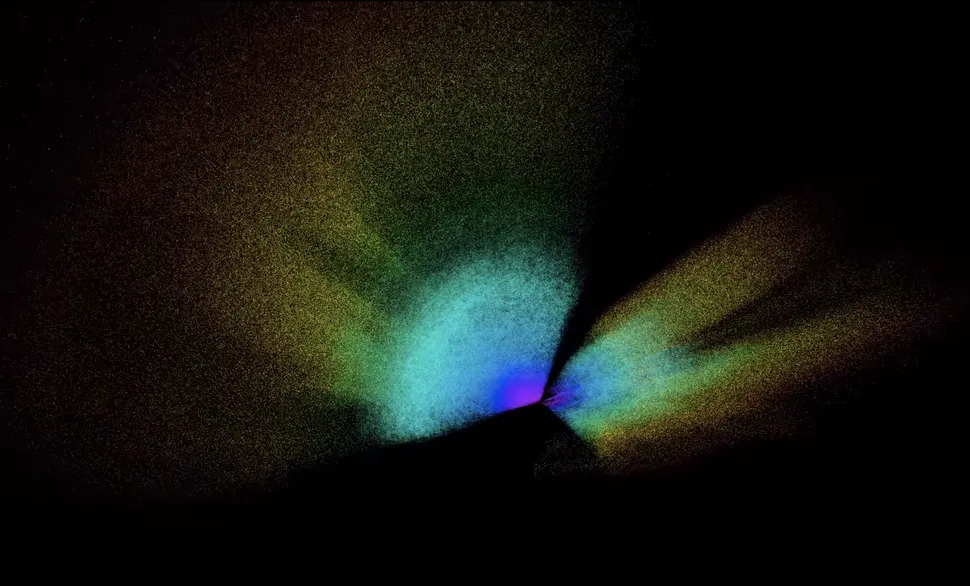
The map includes more than 2 million galaxies and covers 11 billion years of the universe's history. Originally published on Live Science
 |
| Source : livescience.com |
After five years of peering into the deepest reaches of space, researchers have released what they call the "largest three-dimensional map of the universe" ever.
No, you cannot see your house.
The mind-boggling map is the result of an ongoing project called the Sloan Digital Sky Survey (SDSS) — an ambitious, international quest to map the expansion of the observable universe, and hopefully solve a few cosmic conundrums in the process. With this newest update, the project has mapped and measured more than 2 million galaxies, stretching from our Milky Way to ancient objects more than 11 billion light-years away.
Originally published on Live Science
The detailed new map will help astronomers piece together a murky period of the universe's expansion known as "the gap."
The gap begins a few billion years after the Big Bang. Scientists are able to measure the rate of the universe's expansion before this thanks to the cosmic microwave background — ancient radiation left over from the infancy of the universe that researchers can still detect; and they can calculate recent expansion by measuring how the distance between Earth and nearby galaxies increases over time. But expansion in the middle period has been little studied because the light of galaxies more than a few hundred million light-years away can be incredibly faint. To fill in the gap, a team of more than 100 scientists from around the world looked at not just distant galaxies, but also bright-burning quasars (extremely luminous objects powered by the hungriest black holes in the cosmos).
Originally published on Live Science
To calculate the rate of cosmic expansion 11 billion years ago, the team measured the redshift of millions of distant objects along with their velocities — a measurement that shows how much a galaxy is being tugged by the gravity of other matter around it. The team's results, which are described in 23 new studies released on July 20, show that the universe began expanding at an increased rate about 6 billion years ago, following a period of deceleration.
Scientists attribute the universe's expansion to a mysterious force called dark energy, though no one is entirely sure what it is or where it exists. Surveys like this one help scientists better constrain the properties of dark energy, the researchers said, though it remains far from understood. The solution to that conundrum will have to wait for another day … hopefully one not too many billions of years away.
0 Comments